Super Tanning Gummies: $244K gross sales from a $39 hero SKU
A full-funnel case study for a sun-free tanning supplement — Meta as the demand engine, Google as the closer, Klaviyo as the multiplier, and a single source-of-truth pixel tying it all together.
Overview
This is a Meta + Google + Klaviyo + Organic case study for a dtc supplements · beauty client, run by Muhammad Naveed over weekly reporting window. The headline result was $244,894 gross sales (blended). Full-funnel Meta + Google + Klaviyo case study for a supplement brand — $244,894 in gross sales from one hero product.
A single-SKU tanning gummy at $39.95 trying to scale profitably in a category dominated by self-tanners and skincare giants. Meta was burning cash at 0.10 pixel ROAS, Google was the only thing visibly profitable, and leadership couldn't tell which channel was actually paying for itself once attribution overlap was stripped out.
The numbers, side by side.
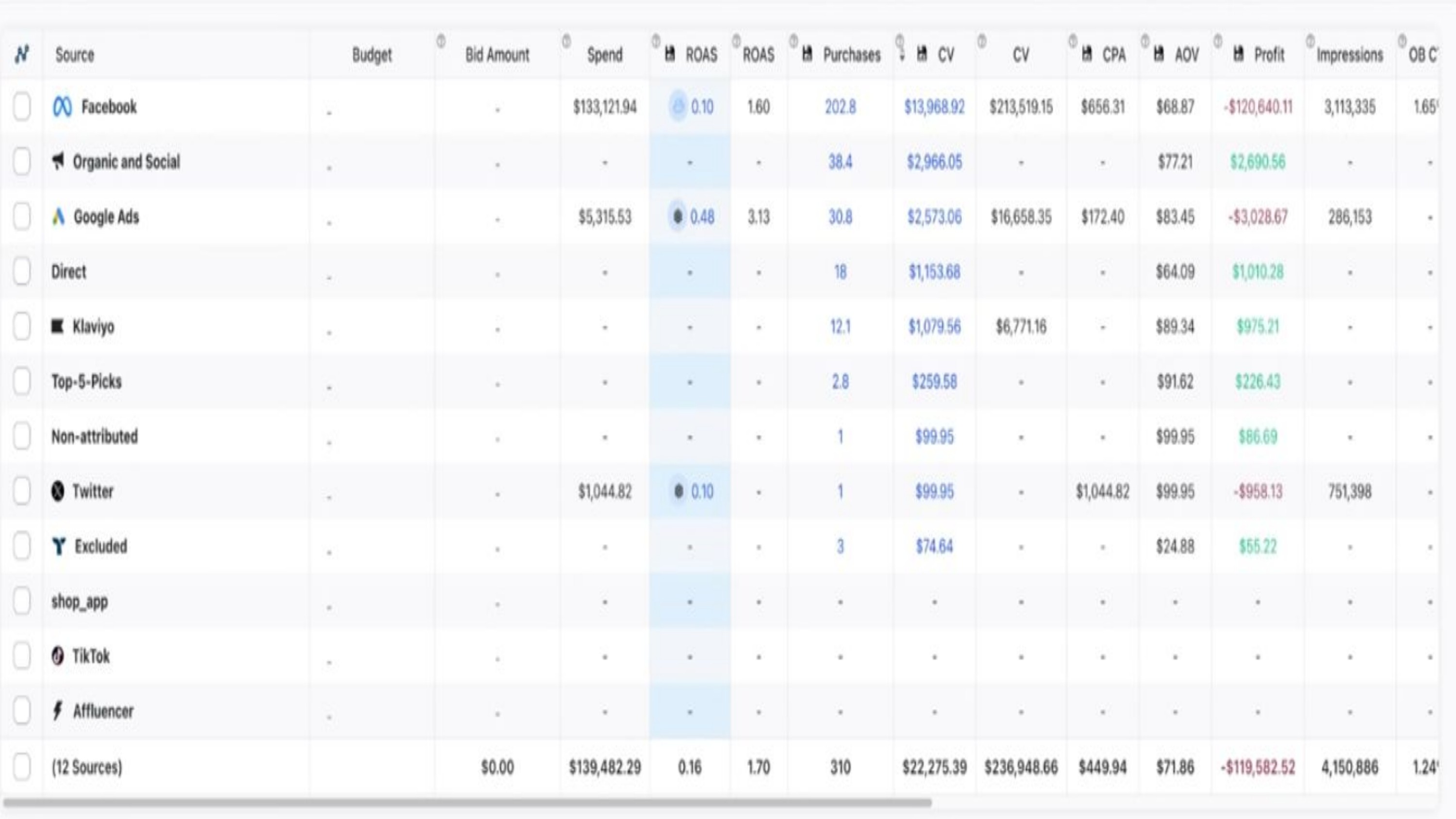
12-source attribution view — Meta drives reach, Google closes, Klaviyo multiplies, blended ROAS 1.77×.
Challenge
A single-SKU tanning gummy at $39.95 trying to scale profitably in a category dominated by self-tanners and skincare giants. Meta was burning cash at 0.10 pixel ROAS, Google was the only thing visibly profitable, and leadership couldn't tell which channel was actually paying for itself once attribution overlap was stripped out.
Strategy
- —Treat Meta as paid reach and creative testing — not the closer
- —Use Google Brand + Non-Brand Search as the conversion floor (Brand 7.35× ROAS, Non-Brand 4.99×)
- —Layer Performance Max on top of Shopping for incremental demand
- —Run all spend through one server-side pixel so every channel is judged on the same ruler
- —Use Klaviyo to recapture every session Meta paid for but didn't close
Execution
- —Rebuilt Google account into Brand Search, Non-Brand Search, PMax and a curated Top-5-Picks PMax
- —Restructured Meta around top-of-funnel reach creatives — accepted 0.10 pixel ROAS as the cost of demand
- —Wired Klaviyo flows to every Add-to-Cart session (790 sessions with ATC, $176 cost per ATC)
- —Built a single dashboard merging 12 sources — Facebook, Google, Twitter, Klaviyo, Organic, Direct, Shop App, TikTok, Influencer, etc.
- —Reported in net profit, not platform ROAS — the only number the founder needed to see
The story
“On paper this brand was 'losing money on Meta'. Pixel ROAS was 0.10. But once we connected every source through one server-side pixel, the picture flipped — Meta was generating the demand that Google Brand Search ($731 conv. value on $146 spend) and Klaviyo ($6,771 revenue from 184 new subscribers) were quietly closing. Blended ROAS settled at 1.77×, gross sales hit $244K, and the brand walked away with $48K in net profit in the window. The lesson wasn't 'kill Meta'. It was 'stop judging Meta on its own pixel.'”
Key takeaways
A 0.10 pixel ROAS isn't a failed channel — it's an unattributed one
Brand Search at 7.35× ROAS is almost always paid for by something upstream
Klaviyo turns one paid session into 2–3 revenue events — count it in the channel math
One server-side pixel ends every 'is Meta working?' meeting forever